Posts tagged: tape

mediageek called the cassette revival way before anyone

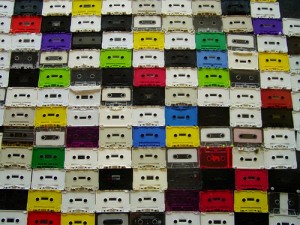
I’m not generally one for tooting my own horn, but here at the end of 2009 it looks like I was a good two years ahead of the curve when I predicted the cassette revival waayyyy back in February of 20022007. I must admit that my prediction was a bit tongue-in-cheek, not so much because I didn’t think it was possible or reasonable, but because my cynical side can’t help but be a little…er, cynical, about resurgences of technology recently considered passé or obsolete.

credit: Steve the Alien / flickr

credit: Steve the Alien / flicr

Earlier this year I noted the appearance of more cassette-based indie rock labels, mostly dealing in very limited-edition runs of EPs and albums. My own recent travels to record stores like Aquarius in San Francisco and Reckless in Chicago turned up small cassette sections in both store where just a couple of years ago there had been none.

But the real cherry on top was stumbling across recent posts all about cassettes at Stereophile magazine, the home of super high-end audiophiles, where CD players can cost $17,000 and speakers require a second mortgage. Stereophile’s Stephen Mejias was himself spurred to think on the subject of tapes by a recent article by Calum Marsh in PopMatters, “Reconsidering the Revival of Cassette Tape Culture.” Critical as Marsh may be about this ferric oxide return, his very tackling of the subject admits one simple fact: a cassette revival indeed has occurred.

And who was there first? Uh huh, that would be the mediageek.

Aside from the fact of my first arrival, however, I’m rather ambivalent on the whole debate on whether or not the cassette revival is just crass indie-marketing sheathed in manufactured street-cred. For those with still serviceable cassette decks I guess it’s kind of nice to be able to get some new tunes that you didn’t have record yourself. At the same time, the reason I have working cassette decks is because I still have music on cassette not duplicated in another medium, and I still find albums on cassette that are expensive or nearly impossible to find in another medium. I guess these special cassette-only releases qualify, in a way, though by design, not happenstance.

It’s not like cassette-only labels are anything new. Labels like ROIR were cassette-only back in the 1980s, and many cassette-only labels have survived in the interim due to economics and ease of one-off duplication and distribution, if for no other reason. The only reason we can call it a trend now is that bands that otherwise have seen relative indie success distributing their music on CDs are turning to cassette labels for limited editions. If it was still mostly the domain of bedroom noise and industrial bands, we probably wouldn’t be reading about this trend in as mainstream a pub as Stereophile.

Now that indie rock collectors and other hip elites can snarf up limited tunes on cassette I’m wondering if we’ll start seeing more plastic fantastic decks show up in Target, and if the used market will inflate. If you’d taken my advice two years ago then you’d probably be sitting pretty on a nice deck that sold for hundreds in the 80s but that would’ve cost you $15. You’ll be spending more on a super-exclusive new tape by a bunch of bearded guys from Portland.

Now I’ll sit back and see if this hot new trend makes it all the way through 2010 and outlives being a trend, like the vinyl resurgence has. Meanwhile, I’ll remind you that my hipster trend-spotting consultancy is still in business, but my rates are going up fast.

Cassettes Are a Weird Way to Distribute Music?

credit: Steve the Alien / flickr

credit: Steve the Alien / flicr

My, oh my, where has the time gone. Sure, cassettes might be nearly obsolete and decidedly retro. But weird?

Wired’s Epicenter blog recently compiled “10 Weird Ways to Distribute Music.” But, really, the list might be more accurately characterized as “10 Unique Ways,” rather than weird. Seems that some popular indie bands like Dirty Projectors are now releasing some albums on cassette again, making the format #8 on Wired’s list. At least blogger Eliot Van Buskirk had the good taste of linking to my somewhat tongue-in-cheek 2007 post titled, “Next Big Retro Thing: The Cassette Revival.”

Of course, distributing new music on cassettes stands out only because the format’s been largely abandoned by the mainstream. I emphasize new music because I’ve certainly seen cheap cassette compilations of country classics and oldies still turn up at truck stops and dollar stores. Cassette-only labels were an underground music fixture in the 80s and 90s due to both the low cost of doing limited edition releases and the relative ubiquity of cassette players.

While mostly overtaken by CD-Rs and downloadable MP3s, cassette labels have survived. Plustapes is a Chicago-based label putting out new independent music on cassette each in limited editions of a hundred or so. Earlier this year the music blog Expressway to My Skull compiled a list of active cassette-only labels and places to find them.

Perhaps the greatest advantage of releasing music on cassette is that it’s possible to record and duplicate albums entirely in the analog domain easily and cheaply without a computer. If you want to get fancy you can find a cassette four-track at a thrift or pawn shop so you have more recording and editing flexibility. Then get a dubbing deck and you’re set. It doesn’t have to be about analog fetishism — it can simply be about being cheap.

Perhaps the enduring charm of the cassette has to do with its fundamental nature as a recording medium that is very accessible, but imposes real practical limits on its duplication. It’s easy for nearly anyone to duplicate several dozen cassettes using inexpensive dubbing decks, but quantities of much more than that require commercial duplicating services. Like ‘zines, cassettes can be a near-mass medium, where you can reach hundreds with a work that the creator still fashioned and touched with her own hands.

Now that we can take for granted the ability to reach a nearly unlimited audience with a perfectly-duplicable MP3 file, there’s something to be said for a sound medium that can’t be had by anyone with a ‘net connection, that didn’t roll off an assembly line. It doesn’t have to be a case of internet vs. cassette; I think there’s room for both to coexist, even in symbiosis.

The Irony of the Vinyl Resurgence

Back in the 1980s when the Compact Disc first hit the market there was great excitement in the high fidelity and audiophile world anticipating the arrival of crystal-clean digital sound that would be unmarred by the vagaries of analog playback long suffered by music lovers. Whether vinyl LPs’ clicks and pops or cassette tapes’ hiss, never mind the inconvenience of turning over sides (auto-reverse cassette decks were still a rich man’s luxury), CD not only promised markedly improved sound but the additional convenience of playing a full 74 minutes of uninterrupted tunes and the ability to skip tracks with the push of a button.

Yet, even as much of the audio, electronics and mainstream press swooned over the new digital audio technology, CD had its critics, too. One of the most famous early attacks came from record producer Doug Sax, published in Billboard and Stereophile magazine in 1983. Sax wrote, in part,

[W]hat I have heard on many players, and on more discs than I would ever care to listen to again, is mediocre sound, sound that is often unappealing and fatiguing. …

I have been on record, since I first heard a digital master tape, that there is an enormous price to be paid, in musical terms, for the noise-free performance of digital.

Reading these words today one should hear their echoes in much of what’s been written about the resurgence of vinyl LPs in the last few years. Of course, now music lovers aren’t just dissing CDs, but pitting LPs against the MP3, which is arguably sonically inferior to the CD it’s coming to replace.

Now a generation after the CD’s introduction we have a vinyl revival, which includes a veritable renaissance in the availability of not just new LP records but turntables and record players. I remember searching for a new turntable back in 1996 to replace my aging plastic Onkyo ‘table that I bought in 1987. Even in small hi-fi shops catering to a audiophile crowd I found it difficult to find any turntables under $1000 or so that would offer much improvement over my 80s vintage Onkyo.

Cheap Plastic Record Player StereoThe problems of noise and poor sound quality with cheap turntables in the 80s is what ostensibly drew people to CDs in the 90s. Back in the 80s a lot of people relied on inexpensive compact stereos sold at discount stores. These stereos typically had a turntable, cassette deck and radio, paired with speakers, all for one or two hundred bucks. While capable of playing music, these systems didn’t tend to have outstanding quality in any element of playback, especially vinyl. You’ll still find these stereos in thrift stores and at garage sales, and if you look you’ll find that almost universally they have very flimsy, all-plastic record players.

Even the more expensive so-called rack systems of the day often didn’t feature turntables of much higher quality, even at price points of $500 or more. Those ‘tables would usually be separate components, but still made of 75% plastic. If you were lucky the platter and tonearm might contain some metal.

Playing records is a completely physical process that is very susceptible to the basic forces of Newtonian physics. If you’ve ever stomped around a turntable playing a record then you probably know how easy it is to make it skip. But it’s not just blunt force that takes its toll. So does vibration and electrical interference from other devices, including other stereo components. The prevalent plastic turntables and stereos of the 80s and early 90s have very little in their construction to shield against these quality-killers — most of the time you were lucky if the turntable had some little rubber feet providing some modicum of insulation.

For the average record listener in the 1980s and 90s, the usual listening experience was littered with surface noise, pops, clicks, skips and jumps that was unfairly blamed on the medium of vinyl records, when much of the fault lay upon the cheap, flimsy playback apparatus. So it was a revelation when these listeners first heard the unfamiliar silence between tracks on a CD where before they’d expected hiss and scratches. Instead of having to listen through the noise for the music, CDs sounded as if the fog of analog grunge had been lifted.

Unlike the enormous difference between the typical plastic turntable and a truly high-fidelity model, by the 1990s even relatively inexpensive CD players delivered on the fundamental promises of noise and skip-free sound.

I’m sure it’s like the shift from black and white to color TV, or from AM to FM radio was for previous generations. For those of us who remember the first time we heard CDs it’s not hard to understand how they quickly took over. Most folks who didn’t spend thousands of dollars on stereo gear truly did experience a step forward in quality and convenience.

Still, Doug Sax was not alone. A minority of music lovers chose to stick to vinyl believing it to sound better than CDs. These audiophiles likely owned turntables costing more than an average person’s stereo, TV and music collection combined, which also delivered on the potential of vinyl’s fidelity. Many others stuck with records for practical reasons–like DJs did–or because they were happy enough with their records. I suspect a lot of people, like myself, stuck with records while also moving to CDs, choosing to enjoy the records we owned while buying new music on CD.

Whatever the reason, those of us who stuck with records are enjoying the vinyl renaissance because it means more turntables, more new records and, strangely enough, some degree of cred. At the same time, I also see a step backwards that isn’t so satisfying.

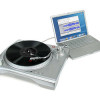
Plastic USB record playerNow that vinyl is retro-popular again it’s ironic that people are flocking to the same sort of cheap plastic turntables that scared folks away from LPs twenty years ago. Within the last year the gadget landscape has been inundated with turntables that connect to your computer by USB, or are attached to CD burners, or which now even record your LPs as MP3s directly to a thumb drive. But almost every single one of these ‘tables is pretty much a plastic late 80s design with some extra digital electronics tacked on. All the more ironic is the fact that the supposed benefit of these new plastic wonders is their ability to let you convert your precious analog records to digital, extra clicks, hiss, pops, skips and all.

I’m not spitting in the face of utility. If you have records which are rare, out of print, irreplaceable, never released on CD or just of sentimental value then I can certainly see why easily archiving them to digital is desirable. What I don’t understand so much is why you’d want to do this archiving at such a low level of quality.

Crosley "retro" turntableIt’s not just these new digitizing turntables. There’s also been an explosion in 80s style compact turntable stereos dressed up in early 20th century retro clothes. Sure the cabinets might look like wood, but inside the record player is the same crap plastic used in that Emerson stereo someone got for Christmas in 1987. Moreover, because the speakers are in the same cabinet, introducing more vibration and interference into the game, these new retro all-in-ones arguably sound worse than the cheap 80s stereo

The funny thing about this is that it’s possible to get a pretty nice sounding turntable made out of very little plastic for less than $300. While not chump change, this is actually about the same as what a decent turntable would have cost in the 80s. Adjusted for inflation, the quality turntable in 2008 costs about $156 in 1985 dollars — less than what you’ve had paid for a flimsy plastic all-in-one stereo.

If you’re willing to invest a little more time and go used, you can pick up nice quality turntables made out of metal and wood that would have cost more than $300 in the 80s for a fraction of that price. Just add a new stylus or cartridge, maybe a new belt, and you’re good to go.

The same phenomenon is happening with cassettes too. There’s almost a double-irony with tapes, which outsold records in the late 80s, before CDs trounced them in the 90s. Besides the convenience of the walkman and car stereo, one of the reasons many people switched to tapes was because they didn’t skip and have quite as much obvious noise as records did (when played on their cheap K-Mart stereos).

Despite my semi-facetious predictions to the contrary, it doesn’t look like a full-on vinylesque revival is happening for cassettes. Nevertheless, USB-connected cassette decks have started to trickle into the marketplace offering up the ability to digitize your tape memories with relative ease. The tech and popular press reaction seems to be a bit more muted for the cassette revival, at least in part because cassettes haven’t quite faded away as much as vinyl had.

I was just a little bit heartened to read a recent CNet review of one USB cassette deck that clearly revealed the flimsy plastic under the flashy digital veneer:

Aside from the USB port on the back, the TapeLink is no better than the cassette deck you probably had in the 1980s, and lacks conveniences such as autoreverse.

More so than with records, I can understand wanting to digitize old cassettes, especially mix tapes or other custom tapes that are difficult to replace or have sentimental value. I’ll also bet that most home recorded tapes were probably created on a plastic 1980s compact stereo to begin with, so there’s likely not so much fidelity lost when digitized using a new deck of similar quality. Of course, if you happen to have a higher fidelity tape–and cassettes could be capable of fine fidelity–you’d probably want to seek out a better, probably non-USB, cassette deck.

While I’m glad to see the resurgence in vinyl and analog music playback in general, I really wish the lessons of the past better informed today’s record enthusiasts–especially those old enough to remember those tacky Emerson, Yorx and Lloyd’s discount store stereos. I fear that for many new or revived record listeners the thin fidelity of these retro-plastic wonders will cause them to tire of vinyl quickly, making LPs more of a novelty than anything else.

Folks got tired of vinyl in the 80s and 90s for a reason: cheap crap plastic turntables. Avoid them now and you’ll still be enjoying your records when you’re less well-equipped friends have tired of their new collections already.

WordPress Themes