Posts tagged: Sony

Admiring Sony’s new NEX-7 but easily resisting the urge

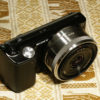
Sony announced a pile of new digital cameras yesterday. I was quite pleased to hear about them, despite the fact that I have no immediate plans to buy one. As I’ve shared here, I’m very happy with my Sony NEX-5 compact interchangeable lens camera. I like having a cam that’s the size of an advanced point-and-shoot, but with a dSLR-sized sensor that delivers better overall quality, and much better low light performance without a flash.

Sony announced a high-end NEX camera, a “prosumer” version if you will, called the NEX-7. I must admit that I do have a little bit of camera lust because it sports a very high resolution 25 megapixel sensor, along with an actual electronic viewfinder, inside a body a little bit bigger than my NEX-5. However, I don’t really know what I’d do with 25 megapixels, since that kind of resolution is mostly useful for very large prints, which I don’t make.

More importantly, I just don’t need a new camera, and I’m resistant to the perpetual upgrade mentality that our contemporary consumer electronics culture perpetuates. Not a single thing about my NEX-5 has changed since Tuesday, the day before the NEX-7 was announced. Like all tools, there are little niggles that bug me about the NEX-5 that might be better on the NEX-7. But I honestly can’t think of one concrete way in which my photography would improve if I only replaced my NEX-5 with the NEX-7.

There’s a oft-repeated adage in photography that “it’s the photographer, not the camera.” (Or as photography blogger & gadfly Ken Rockwell puts it, “it’s not about your camera.”) In general terms, I most certainly agree. An experienced photographer knows a camera well enough to know how to get the picture he needs from it. Many great cameras have been used to take crappy, or just mundane, photos.

An experienced photographer also knows when a particular tool is not right for the job. But this caveat has more to do with significant differences than minor upgrades. For instance, a 110 film camera is likely an inferior choice to shoot a photo for a billboard as compared to a medium-format camera with a much larger negative. That’s a fairly extreme example, but the idea should be clear.

Looking at the NEX-7, even though there seem to be operational improvements–like the addition of two customizable control dials–that may make it easier to control the camera, I can’t say that will necessarily result in better photographs than what I’m taking now. Just because I might want it doesn’t necessarily mean I need it, or that it will even be that much of a real improvement in my actual photography. My photography will improve more if I just go out and thoughtfully shoot more photos than if I save up for or buy a new camera instead.

So then, why do I care about the NEX-7? Frankly, I’m glad to know that Sony seems to be committed to further developing the NEX line of cameras. Along with the 7 Sony also announced three new E-mount lenses that fit the NEXes. Despite the fact that many photographers upgrade cameras with every change of season, for me a digital camera is not an insignificant purchase. I like a camera body to last me years, not months. Therefore I would prefer not to feel like someone who purchased a brand new $500 HP Touchpad a month ago, only to see the whole product line now discontinued and clearance priced at 99 bucks.

Even if Sony did abandon the NEX line it wouldn’t be the end of the world. My camera and lenses would still work, and I don’t really need to buy that many more lenses or accessories. Nevertheless, I am glad to know that there’s a good chance that in five years or more Sony will have an up-to-date NEX model camera available should I need to replace mine or upgrade.

I will continue shooting with my NEX-5, feeling just a little more secure that my favorite little camera isn’t an orphan.

Speaking of my NEX-5, I recently purchased a cheap and fun little lens that easily adapts to the NEX, and that won’t work with a bigger dSLR. That will be the subject of my next photography post.

Considering video/still convergence and Sony’s NEX-VG10 interchangeable lens camcorder

Back in May I wrote about the vexing mix of features in Sony’s new NEX interchangeable lens digital cameras. While visiting a big Chicagoland electronics megastore I finally got my hands on the NEX-3 and NEX-5 cameras and came away liking them more than I expected. Though I only got to play with them for a few minutes I didn’t find the user interface to be as frustrating as I predicted. I rarely shoot in full manual mode, generally preferring aperture- or shutter-priority. So changing aperture or shutter using the back control dial was fairly intuitive and easy.

I was truly blown away by the form-factor. These are tiny cameras! Without the lens they’re the size of a typical compact point-and-shoot. With the lens they’re no bigger than so-called “bridge” cameras of the sort that look like mini-SLRs. The fit and finish is very nice, and the lens casing feels top-notch. Some of my initial concerns still remain, especially the lack of true manual exposure control when shooting video along with the lack of a microphone input for video. Nevertheless, I came away more intrigued than before when I’d only read about them.

Answering some of the concerns about the video capabilities of the NEX-3/5 Sony is releasing a camcorder using the same large APS-C sized image sensor and interchangeable lens mount, named the NEX-VG10. The Luminous Landscape just published a hands-on review of the camcorder, giving it a qualified recommendation. It seems like most of the weaknesses of the camera lie in firmware — that is, features that are programmed in rather than part of the physical mechanics of the camera. In particular, there’s limited exposure monitoring making it difficult to see when you’re clipping the highlights. I find that omission particularly surprising, since it’s included in nearly every pro-sumer Sony camcorder I’ve used in the last decade.

The idea of having a still camera and a camcorder that can share lenses is quite exciting, as is having a true video camcorder–not just a still dSLR with video capabilities tacked on–sporting a large high-quality sensor that’s nearly the size of 35mm motion picture film. All the more amazing is that the still camera costs well less than a grand and the camcorder costs just under $200 with lens. This approach promises to be a game-changer in many of the ways that video dSLRs shook up the digital video world.

Panasonic has also announced its own version of an interchangeable lens camcorder based on still-camera sensor, the AG-AF100. Panasonic’s version is based around the micro 4/3 standard behind still cameras like the Olympus Pen series and the Panasonic GH-1. The AF100 is still a little further away from stores, and looks to be a bit more pro oriented than the Sony, with the inclusion of XLR mic jacks and more exposure options. It also looks to be more expensive, at a price around $6000.

I find the Sony cameras to be so interesting because of their price, and because I’m already an owner of a Sony dSLR. While Sony dSLR lenses don’t mount directly on the new cameras and camcorders, there is adapter that lets you use them.

I’m not quite ready to jump into a new camera, camcorder or lens-mount system, but am seriously considering taking the plunge with the NEX-5 or its successor. To add more grist to the mill, dSLR News Shooter has a short review of the NEX-5 as a video camera for the working journalist.

In any event, I will be keeping close watch to see what develops. Exciting times, indeed.

Sony teases me with their new, but frustrating NEX digital cameras

Fuji Finepix A101 - my first digicam

Digital photography turned me into a photography enthusiast. Although I’ve been shooting video ever since I first got my hands on a black-and-white 1/2″ reel-to-reel VTR as a kid, for some reason still photography never interested me much in high school or college. But in 2001 when I got my first miniDV camcorder which also had a still image recording I awoke to the allure of photography.

Like a lot of people, I started with a very simple point-and-shoot digicam–a Fuji sporting a full 1.3 megapixels–before eventually getting a digital SLR in 2006. Instead of going with a Nikon or Canon, I decided to take a chance on Sony’s very first dSLR introduced after acquiring Konica-Minolta’s camera division, the a100. Although I had a few Nikon lenses to go with some old film SLRs, I didn’t think my investment in glass was substantial enough to make a Nikon dSLR necessary.

The Sony a100 dSLR

I chose the Sony a100 primarily for one big reason: in-body image stabilization. Nowadays Olympus and Pentax offer this feature, too, but in Oct. 2006 the a100 was the only a100 that had it. With a Nikon or Canon dSLR you can buy lenses that have image stabilization, but they’re more expensive than non-stabilized ones. With the a100–and now, any Sony dSLR–every lens you mount on it is stabilized. What this means is that you can take pictures with longer shutter speeds, such as in low light, minimizing the effect of camera shake, making for sharper pictures.

I can find things to quibble about in the a100, but I’ve been quite happy using it for the last three and a half years. No gadget is ever perfect, and a good photographer learns his way around his camera. I’m quite familiar with its operation and quirks, and satisfied with the images I obtain. I don’t use this camera professionally, but I’ve built up a small collection of nice lenses. Aside from the fact that newer models offer lower noise at high ISOs in lower light, and have higher resolution, I’m not particularly tempted to trade in my old a100 yet.

However, I have been quite tempted by the new compact mirrorless interchangeable lens cameras in the micro-four/thirds mount like the Olympus Pen series and the Panasonic GF-1. They offer image quality on par with dSLRs in bodies closer to the size of larger point-and-shoot cameras. I’m tempted because I like having a compact digital camera, but have been generally disappointed with their image quality. They tend to be fine for casual shots in daylight, but suffer quite a bit in anything dimmer. Furthermore, as I’ve become a more experienced photographer I like to use manual controls and these are often missing or very limited on digital point-and-shoots.

Then at this year’s Consumer Electronics Show Sony previewed a new line of interchangeable lens compact cameras to add to its Alpha line. I’ve been cautiously excited as various details were rumored and leaked. Today the real cameras were announced, and I’m a little disappointed.

Sony NEX 5

Aesthetically the two new cameras, named the NEX 3 and NEX 5, look very cool, with styling that doesn’t quite look like any other camera out there. The camera body itself is very thin and compact, with the higher-end NEX 5 constructed from sturdy magnesium. They also have dSLR-sized (APS-C) sensors sporting 14 megapixels, which are bigger than both high-end point-and-shoots like the Canon G11 and Olympus and Panasonic micro-4/3 cameras. Finally, also in the plus column, they both shoot full 1080i HD video, where the other cams top out at 720.

Unfortunately, there are two big minuses that dump some cold water on my enthusiasm. The biggest drawback is that they don’t have in-body image stabilization. Given that this was why I chose a Sony dSLR in the first place, this is a big disappointment. By comparison, all the Olympus Pen cameras have in-body IS, although the Panasonics do not. I understand that the NEXs lack IS so Sony could make the camera bodies thinnner. But, I, for one, would gladly take a slightly thicker camera in exchange for the IS.

To be fair, Sony plans to offer lenses with IS to fit the NEX cameras, just like Panasonic does for its micro-4/3 cameras. However, Sony isn’t putting IS in all their lenses, and the first two being offered don’t have it.

The second minus is that the cameras use a new lens mount, meaning Sony’s A-mount dSLR lenses don’t work without an adapter. Now, I was expecting this possibility, since micro-4/3 was a new mount requiring an adapter to use older Olympus and Panasonic dSLR lenses. So by itself, this isn’t a huge deal. But the adapter won’t support autofocus using the Sony dSLR lenses. To me, this significantly undercuts what could be a big advantage of choosing a Sony NEX camera–the ability to leverage my existing Alpha lenses.

Because of the unique design advantages of these mirrorless interchangeable compacts, a thriving aftermarket in lens adapters has sprung up. Now you can get adapters for an Olympus Pen or Panasonic GF-1 what will allow you to use just about any 35mm lens in existence. The caveat with these adapters is that they also don’t support autofocus.

But I can actually get a Sony lens adapter for an Olympus E-PL1, which has in-body image stabilization, my most coveted feature. Given that, why would I buy a Sony NEX 3 or 5 which offers no better Alpha lens compatibility and lacks image stabilization?

That said, the NEXs aren’t in stores yet and I haven’t had my hands on them. The preliminary hands-on previews and reviews I’ve ready are generally positive. There’s mostly praise for the cameras’ size and the handling, along with good reports on image quality. Based on some image samples I’ve seen, four years of sensor advancement give much better low-light ability than my a100 in a body much closer in size to a point-and-shoot.

At the moment I’m quite undecided as to whether I want to take the plunge with an NEX or a competitor like an Olympus Pen. With a few rare exceptions, with tech gadgets you rarely lose by waiting to see what lies around the bend. Sony might introduce follow-up models with in-body IS (though I kind of doubt it) or that can autofocus Alpha-mount lenses (somewhat more likely). Or Olympus might offer up something even more tempting that makes me forget the NEX’s 1080i HD video and better high-ISO performance.

So that means I’m going to wait and see, saving my hard-earned dollars for the moment. It’s fun just watching and having something to look forward to.

WordPress Themes