Posts tagged: flip

Pick up a Sanyo Xacti VPC-CG10 for just $109

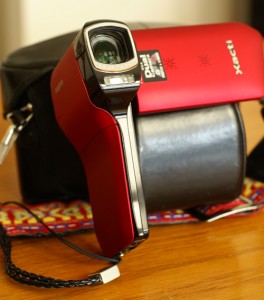
Sanyo Xacti VPC-CG10

I don’t normally go in for deal tracking here at mediageek, but this is one I have to pass on. Thanks to Scott Eggleston at the Frugal Filmmaker, I just learned that B&H has my favorite palm-sized camcorder, the Sanyo Xacti VPC-CG10, on sale for just $109. That’s a good 40% less than what I paid about sixteen months ago.

Although Sanyo has released several newer models in the pistol-grip Xacti line, none of them appears to be much of an upgrade over the CG-10, which was Sanyo’s first HD camcorder coming in under $200. What I like about the CG10 over similar palm-sized camcorders from Kodak and Flip is that it offers manual control over exposure, focus and ISO. You do have to work a little bit to get these settings the way you want them, and you can’t change them while shooting. Nevertheless that modicum of control permits the more serious videographer to squeeze more performance from this camcorder than its competitors.

To get better video performance in a similarly small package I think you have to step up to one of Sanyo’s high-end HD palmcorders costing more like $400, or get a high-end point-and-shoot digital camera like a Canon G12 or Panasonic LX5.

At just $109 the CG10 really can be the kind of camcorder you don’t worry about throwing in your bag or putting in your pocket to take just about anywhere. Remember, often the best camcorder is the one you have with you.

Zoom finally adds HD video to a portable audio recorder, but still no mic input

Mobile Podcast StudioI’m always complaining about how most consumer-level camcorders don’t feature microphone inputs, or even decent mics. My Sanyo Xacti VPC-CG10 has pretty good mics for camcorder of it’s size and price. But because the mics are on the camera and there’s no input to add an external mic, they’re still inappropriate for interviews or any sort of shoot where you need to record voices clearly because the mics will be too far away.

I’m a big fan of Zoom’s portable digital audio recorders — I’ve been using the small Zoom H2 for a couple of years now. Last year Zoom released their Q3 “handy video recorder” which added a standard-definition camcorder to a high-quality stereo audio recorder. Strangely, the Q3 lacks a microphone input, although its mics outclass anything on a camcorder.

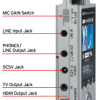
Zoom Q3HD inputs

Now Zoom has upped the ante by adding HD to create the Q3HD, featuring full 1080p HD video. I’m surprised that the Q3HD still lacks a microphone input, however it does add a line input. In its promotional literature Zoom says that the input is good for recording multiple microphones using a mixer “for sophisticated recordings.” While this is certainly useful, I question whether someone using a tiny hand-held camcorder wants to drag around a mixer and multiple mics just to get better sound. Being able to just plug in a single lavaliere mic would be much more practical.

Like most Flip-style camcorders the Q3HD has no optical zoom, and doesn’t seem to have much in the way of manual control over the video. So, in essence it’s a Flip camcorder with vastly improved audio. I think it would be vastly more useful if Zoom were to combine something like a Sanyo Xacti style camcorder, that has an optical zoom, with the enhanced audio recording of their “handy recorders.” That would really make for a DIY videographer’s dream pocket camcorder.

The Q3HD is supposed to be available by the end of the year for $299. My guess is that the street price will be a good bit lower than that. However, I’d gladly pay $300 or a bit more for my dream of an Xacti + Q3HD.

The best camcorder is the one you have with you

Kyocera T Proof = Yashica T4 Super

There’s a common idea amongst serious photographers that it’s a good idea to always have a camera on you, because you never know when you’ll see the stuff of a great picture. Seeing as how it’s often impractical to always have an SLR or other larger camera with you, many photogs adopted smaller point-and-shoot cameras they could easily toss into a bag or even keep in a pocket. In the digital age these are often called “serious compacts,” because they offer enough control for the experienced photographer without being enormous.

In fact, many photographers over the years have argued that the moment a great photo happens is far more important than the gear you use to shoot it. That’s why many will contend that your camera doesn’t matter or that the best camera is the one you have with you.

While these ideas seem to be quite common in still photography I don’t often hear them repeated in video circles. It could be that photos and video often are thought of differently, or perhaps serious videographers look upon video shot in the moment to be too much like bad home videos to be taken seriously. Or maybe it’s because it’s a very recent occurrence that there are video cameras that are as small as compact still cameras.

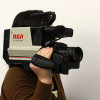
Not exactly pocket-sized.

Home video camcorders are about thirty years old now, but for the first ten years of their existence they were big shoulder-mounted affairs. In the 1990s the birth of 8mm, VHS-C and then miniDV led to so-called “palmcorders.” Yet, they were still a little bigger than most film SLR cameras. That is to say, one might take it on vacation to record special moments, but only a dedicated few would take one on a walk through the park or to a party.

In the early 2000s there were several miniDV camcorders shrunk down to about the size of a couple of paperback books. While this seems to have encouraged more folks to carry camcorders with them, the relative delicacy of their complex tape mechanisms and the need to carry blank tapes still served as discouragement from keeping one in your bag all the time.

By 2005 the ability to record video crept into most point-and-shoot digital cameras. At this point I think a lot of average folks started to take more video, primarily because it was simple and built into the camera they were hauling around anyway. But the quality of the video still was lacking compared to a decent dedicated camcorder, often with much poorer sound. So while many more videographers played around with their digicam’s video function, it doesn’t seem like they were taken too seriously.

Now we’re finally at the point where there are good camcorders that will fit in your pocket. Whether it’s a Flip cam, a Sanyo Xacti like I use, a point-and-shoot digital camera with HD video or even an iPhone 4 it’s possible to shoot quite credible video using a device only slightly bigger than a miniDV videocassette. Thus begins the era wherein serious videographers can indulge in taking “video notes” of daily life and events in the way still photographers have been doing for decades.

I’ve realized that’s the real value to small camcorders, having the ability to easily shoot video without a lot of planning and schlepping. As a result I think I’ve shot more video with my Xacti VPC-CG10 in the last year than I shot with my miniDV camcorders over the previous nine years. The miniDV camcorders, as relatively small and easy to use as they were, still required more forethought and planning, along with carrying an extra bag for the camera and tapes.

What I’ve really enjoyed is shooting short “slice-of-life” videos that last no more than a few minutes once edited down. Not coincidentally, this is the perfect length to share on the web. So I also think that having the ability now to share HD quality video so easily on the web contributes to the value of the pocket-sized camcorder, where before the venues to share such video widely were quite a bit more limited.

I’ve got quite a bit of video in the queue waiting to be edited. Luckily, sometimes I end up with a solid 3 minutes that requires minimal editing. As an aside, while I still lament the lack of a proper microphone input jack in most small camcorders, I continue to be amazed at the quality of the sound recording in my Xacti VPC-CG10. It truly rivals the quality of dedicated digital audio recorders like the Zoom H2. The Xacti doesn’t quite measure up at the low-end, and emphasizes the midrange a little more than I’d like. But a little equalization cleans that up pretty easily. I now notice that the new Sanyo VPC-PD2 that I wrote about yesterday sports some fairly serious looking microphones that I am curious to hear.

Here’s a short video I shot of the classic post-punk band Mission of Burma at the Wicker Park Fest street fair here in Chicago a couple of weeks ago. This was shot hand-held from the crowd in the street. There was no room for a tripod or monopod. The only reason I was able to grab the video was because I had the camera in my bag and could easily grab it. I’m able to hold the Xacti much more still than a Flip style camcorder because of it’s pistol-grip design and flip out screen which makes for a more stable two-handed grip.

The sun was starting to go down so I switched the CG10 into black and white mode which I think works better in low light. I accidentally underexposed it a little, as I’ve learned that the LCD screen isn’t the most accurate way to judge exposure, so I had to boost the gamma in post. This makes the video a little more contrasty in a way that I like and is more film-like, but it may not be everyone’s cup of tea.

Interesting new Sanyo flip-style camcorder

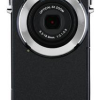
Sanyo just announced a new Xacti camcorder that looks interesting due to the way it breaks from the company’s typical pistol-grip style camcorders and due to its lens. The VPC-PD2BK has a form-factor more like the Flip-style cams, but with a 3x zoom lens that looks like it came from a compact still digicam, therefore also featuring a faster maximum aperture of f/3.1 than on their pistol-grip style cams which usually start at f/3.5. Every little extra bit of light gathering helps.

As I’ve noted before, while I really like my Xacti VPC-GG10, I find that it’s lens is not up to the standard of the average digicam. In everyday use this matters less for video than for still pictures. But this better looking lens on the new PD2 gives me some hope that perhaps this cam will deliver better stills alongside full 1080p HD video (alas, only at 30 fps, rather than the cinema standard of 24p).

The PD2 also doesn’t include a mic jack or optical image stabilization–two features which would be very welcome. But at a pre-order price of $169 over at Amazon, if the quality matches or betters the VPC-CG10 (which is what I’d hope), the PD2 may still be a very appealing option for videographers looking for more flexible image control than available with the typical Flip-style cam.

Hey Sanyo, if you’re reading, how about sending me one for review? I promise to send it back ;->,

Putting the Xacti VPC-CG10 camcorder to work DIY style

For all you filmmakers w/ $25k budgets, this is what NO-budge... on TwitpicAs I’ve blogged before, I’m having a blast using my Sanyo Xacti VPC-CG10 palm-sized HD camcorder. I’m starting to hear about other videographers who appreciate the CG10 not just for its cost, size and HD, but also for its manual control over exposure and focus.

I just read a quick post at the Frugal Filmmaker about writer and actor Curtis Hendley using some great DIY lighting techniques to shoot video on his CG10. Frugal Filmmaker Scott Eggleston even points out the CG10′s manual controls. Also, make sure to take note of the fact that the CG10 in the photo is on a tripod, which is the best way to make sure your video comes out better and more polished.

I’m actually working on a blog post discussing how to put the Xacti camcorders’ manual controls to good use in just about any setting, and how that will make your video look just that much better than anything that comes from a Flip-style camcorder, or even a shiny new iPhone 4.

From miniDV to dSLR – Contemplating the New Era of Digital Video

Canon Elura, a classic miniDV cam from the early 2000s (photo credit: Capa_r2 / flickr)

When I saw the first miniDV digital camcorders in the late 1990s I was blown away by the edit-ready broadcast-quality picture they captured on tapes half the size of an 8mm videocassette and on cameras smaller than ever seen before. Yet, I couldn’t predict that only about a decade later we’d see the ability to shoot high-definition on tapeless cameras, with the ability to nearly instantaneously upload that video to the internet. In the previous ten years (roughly 1989 – 1999) we saw the evolution of the consumer camcorder from bulky shoulder-mount VHS and Beta cams to smaller, compact 8mm and Hi-8 camcorders. With Hi-8 we finally saw near-broadcast-quality video in compact cameras costing a few thousand dollars, rather than tens of thousands. That was certainly a leap, but still not as huge as what we’ve seen in the first decade of the 21st century.

Director Mike Figgis and his DV camcorder on the set of Timecode.

The ground-breaking quality and adapatibility of DV and miniDV camcorders caused many independently-minded filmmakers to use the format to shoot films that would probably have been too expensive to undertake using film. Indie films like Mike Figgis’ Timecode, Jennifer Jason Leigh’s The Anniversary Party and Richard Linklater’s Tape come to mind. All were more experimental, in some specific regard, than even most independent films of the time. And all used the small form-factor of DV camcorders, along with the low-cost of shooting multiple cameras, to do things that maximized the utility of these features.

Canon Rebel T2i

This reminiscence is sparked because this past week I had the opportunity to try out a colleague’s new HD video capable digital SLR, the new Canon Rebel T2i. The low cost and new HD quality threshold now transcended by video dSLRs are catalyzing a similar new wave of indie film and video innovation. So I was glad to finally have the opportunity to lay my hands on a video dSLR and put it through its paces, accompanied by my talented colleagues.

We tested it out in a studio with some studio lighting, using just a kit lens, to see how it would fare compared to HD video cameras that we use everyday, like the Panasonic HVX-200. The results were very impressive, arguably besting what I’ve seen with the current generation of prosumer HD camcorders used by educational and event videographers and indie filmmakers.
Read more »

Making the HD Camcorder Leap with Sanyo’s Xacti VPC-CG10

Sanyo Xacti VPC-CG10

Sanyo Xacti VPC-CG10

Over the last three years I have not been shy about airing criticism of the newest wave of low-cost flash memory camcorders shooting alleged high-definition video. My critique has largely rested upon video quality being lower than established tape-based HDV camcorders and the difficulty of editing footage shot in the highly compressed AVCHD format.

Kodak Zi6 HD camcorder

Kodak Zi6 HD camcorder

The last time I posted on the topic was about a year ago when I took on Kodak’s entry into the field with the first HD camcorder priced under $200 the Zi6. I started to warm to the concept based upon the low price which then also makes higher quality videography more widely accessible. I never had a chance to get my hands on a Zi6 until very recently when I was in a store to check out a different model of inexpensive HD camcorder, which I’ll get to in a moment. The Zi6 takes on the Flip camcorder style form factor. That is, it’s shaped like a bar-style cellphone, with a lens on one side and a screen on the other. The controls are largely limited to record, stop and play with the intent to keep operation simple and easy.

Finally this year I began seriously to consider taking the plunge with one of these small HD camcorders. There were two motivations. First, I realized that I barely used my miniDV camcorder any more, bogged down by its relatively large size and the hassle of having to capture tapes in real-time. Second, I tried to make some videos using my digital camera. While the camera’s specs say it shoots video in a resolution equivalent to full standard definition DV (640×480) I found the resulting footage to be really lacking in quality. On top of that, the video files were recorded in a relatively inefficient and obsolete format.

Although the simplicity of the Flip-style camcorders hold some appeal for me, I’m really not sure I can be satisfied with their lack of manual adjustments, zoom and other basic camcorder settings. I recognize how the average user probably doesn’t care and doesn’t miss them, and that the Flip brand camcorders have succeeded because they deliver good video with absolute operational simplicity. But I’m a bit more of a power user than that.

My Xacti CG10 and it's box in Radio Shack red

My Xacti CG10 and it's box in Radio Shack red

Then I got wind of Sanyo’s newest and least expensive camcorder in their Xacti line, the VPC-CG10. I was enticed by both the price, under $200, and the fact that it has a real optical 5x zoom. Sanyo advertises the model as a “Dual Camera” because it is both a 10 megapixel still camera in addition to shooting 720p HD video. I learned that the Radio Shack near work had the Xacti and a few other low-cost HD cams in stock and stopped in on my way home to check them out.
Read more »

HD Video for under $200?

Last month Kodak announced its entry into the hot mini-camcorder market, obscurely named the Zi6. Kodak’s big splash with the Zi6 is that it offers HD video for just a little bit more than the standard-def Flip camcorders.
Now, Sanyo has had an “HD” flash memory camcorder on the market for a while, though reviews have been definitely lukewarm. The difference between Sanyo’s offering and Kodak’s is that the Zi6 has a retail price of $179 vs. Sanyo’s $600+ pricetag.

As I’ve mentioned before, my interest in these small flash memory camcorders has been piqued, primarily because it seems as though their balance of quality and convenience makes sense at the less-than-$200 pricepoint. By comparison, the somewhat more fully featured Sanyo Xacti’s seem like they don’t quite offer enough overall quality for the price.

I’ll admit I was intrigued when I read Kodak’s announcement for the Zi6, but I’m also skeptical about how high the high def can be at $179.

CNet recently reviewed the Zi6 and they confirm some of my skepticism, while still giving it a good review of 7/10. It seems that the lens may not be up to the same quality of the sensor, with the reviewer noting that the HD images seemed soft, but was still sharper when scaled down to YouTube video resolution. The review also criticizes the paltry 128 MB of internal memory which is enough for only a few minutes of HD video. Luckily, the Zi6 takes SD memory cards, though adding thing adds to the overall cost.

I’d really like to get my hands on one of these and put it through its paces. I’ll have to see if any camera or electronics store will have them out for testing. Otherwise I may just have to bite the bullet and order one.

In any event, it seems like the trajectory of digital video is clear, and HD video shot onto memory cards is where we are going. As long as that video is easily edited on your average Windows PC or Mac, then I consider this to be a good thing.

Wired Gadget Lab on Flip Mimo: Good, maybe not work extra bucks

Those of you following these little flash-memory pocket-cams like I am might be interested in Wired’s Gadget Lab review of the new Flip Mimo, which is a smaller, slightly more feature-rich version of their signature $150 Flip camcorder.

Though slimmer and prettier the Gadget Lab concludes:

It’s a solid little cam that’s easier to transport, simpler to re-charge, infinitely sleeker, and about as easy to use at the Ultra (once you get accustomed to the touch buttons). But at $180, the price just doesn’t seem quite right.

Unfortunately I haven’t had a chance to muck with the video function on one of my digicams yet. Though I went to my brother’s wedding this last weekend in scenic Baltimore, the battery on my cam crapped out early with no good opportunity to recharge. I did, however, discover while playing around on the ride to Midway Airport that the video on my Treo 755p smartphone sucks rocks.

Reconsidering Solid State Video

The face of digital photo and video is changing as we speak. Well, not really the face, so much as the skin and innards. Until very recently video = tape and photo = memory card. Now, tape is on its way out, and digital still cameras are getting much better at doing video, too.
Flip camcorders

One of the most unusual aspects of this process is that it’s happening at the low end, not the cutting edge. While it’s true that many HD video shooters are now using some kind of (expensive) memory card, for the most part tape or some kind of disc still rule professional production. But at the consumer level, especially at the $100 – $200 solid state memory is winning.

This development has been on the horizon for quite some time, but it’s really only in the last year that inexpensive flash memory camcorders and point-and-shoot digicams have provided a decent enough quality and user experience to surpass the traditional tape-based camcorder.

The reasons are pretty obvious. While a miniDV camcorder was absolutely miniscule compared to the behemoths of the analog age, new memory cams are the size of just one or two videotapes. There’s an old adage in photography: the best camera is the one you have with you. This extends to video, too, if the type of video you’re shooting is a lot like snapshots–recording interesting or important moments for posterity or fun.

The second reason is price. With no moving parts and Moore’s Law chugging away in the background, the silicon pieces that make up a flash memory camcorder get cheaper every day.

I have to admit that I’ve resisted this trend for a while, due to both good reasons and snobbery. On the side of good reasons, flash memory is actually more volatile than videotape, and until recently the cost-per-minute of memory cards was extremely greater than miniDV tapes. With a memory card you have to make sure to upload the files, and keep backing them up if you want to preserve your footage. With tape you can capture what you need, or not even bother to transfer your video to a computer for months or years. Just keep the tape in a safe place and it will be ready when you are. Doing that with a memory card just isn’t practical.

My final good reason is that the video files that come off these little flash memory cams is highly compressed and not designed for editing. I’ve blogged about the problems this presents with the more expensive HD camcorders, and these problems remain. But at the $100-$200 end of things that concern is pretty much moot. If you have a recent vintage PC or Mac pretty much any recent editing program, from iMovie to Premiere, will handle their standard-definition footage.

So what are my snob reasons? Well, the video quality of a $150 Flip camcorder isn’t great. Most miniDV cams are better. That said, the Flip really is awesome for a $150 camcorder that fits in your pants pocket and is still better than most old school analog cams. Another snob reason is that there’s no audio input or headphone jack. In fact, most of these flash memory cams don’t have much in the way of controls or jacks at all, besides record, stop and USB. But, then, that’s what’s making them so appealing.

My snob reasons are in same category of arguments that pixel-peeping dSLR freaks espouse on internet message boards all over the place, arguing why their $2000 Nikon or Canon makes their pictures so superior to your $200 Kodak. Of course, the thing they’re missing is that the SLR with the 200mm zoom lens doesn’t fit in your pants pocket, and sometimes won’t even fit in a daypack.

A reasonable person will see that the question isn’t what’s better, but what’s the best tool for the job. Reading more about very positive real-world experiences with camcorders like the Flip is making me more interested in trying them out myself.

Funnily enough, I own a small pile of point-and-shoot digital cameras, all of which have some sort of video function, and I’ve never really tried out their video function. That’s probably a pretty good place to start, given I don’t have to buy anything new for that trial.

If you’re interested in trying out one of the new $150ish pocket camcorders, Gizmodo has a nice comparison of six recent models. Spoiler: the ever-popular Flip Ultra wins.

I have more thoughts on the convergence of digital imaging and video that I’ll be sharing in the coming weeks.

WordPress Themes