Category: audio

Don’t Be Spooked by Threats of Obsolesence

One of the unfortunate effects of our capitalist economy is the constant drive for new and better. Well, really it’s mostly new and novel, with better being a secondary consideration. That means obsolescence is something that constantly looms over industrial products, especially tech products. But obsolete does not equate with useless or worthless–not remotely.

With the rising popularity of digitally downloaded music, whether through file sharing or an online store, the imminent death of the physical compact disc continues to be predicted. The cries have become louder in the last few weeks as Atlantic Records announced that its digital download sales (which includes ringtones) surpassed its sales of physical CDs.

I’ll admit that these days I probably listen to more MP3s than CDs, especially on the go. Yet, I still have a collection of over 1000 CDs, most of which I have not ripped to MP3–my MP3 collection is comprised mostly of purchased music and stuff I’ve traded with friends. I do still listen to CDs, especially when I want to listen critically. I realize that absolute fidelity is only one factor in how we choose to listen to music, it’s still important to me and many other people. While MP3s and other compressed files can sound quite good, they are no match for the uncompressed source.

That’s why I’m not surprised to read a Wired Gadget Lab post directing me to this story from the UK’s Telegraph reporting that the sales of portable CD players there are up 50 percent over last year. Amongst the reasons they cite are price ( I’ve seen units here sell for $15 or less) and the fact that many people find using a computer to download to an MP3 player to be difficult.

One very obvious reason I want to add to the list is that maybe a whole lot of people aren’t interested in giving up their CDs in the first place. If you aren’t interested in dealing with the iTunes music store (especially if you don’t want to pay the iPod price premium) or any other online music store, and you don’t relish the task of having to rip and compress your CDs yourself I can see how the supposed convenience offered by MP3 players and digital files can look pretty darn inconvenient.

Folks over 30 can probably remember when they got their first CD player, moving over from listening primarily to vinyl LPs or cassettes. I knew a lot of people who all but dumped their analog music collections for CDs in the early 90s, lured in by the promises of better sound quality and convenience. By and large those promises were fulfilled, compared to the lo- to mid-fi sound experiences most people were accustomed to getting from inexpensive cassette and record players. But it was also a pretty big cash outlay for a lot of people, many of whom replaced their music collections with the same titles on CD as the popular press sounded the funeral march for the soon-to-be-obsolete vinyl LP.

Now twenty-six years after the introduction of the CD we have none other than the New York Times writing about the resurgent interest in vinyl records, sales of which are up 36% this year. Weren’t these fragile, scratchable, pop-and-click-filled analog dinosaurs supposed to be a curious historical artifact by now?

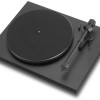
Myself, I never abandoned my record collection. When I bought my first CD player in 1987 I also bought my first decent turntable. From 1988 through the mid-90s I really cleaned up buying used vinyl for a song as other music lovers dumped their obsolete analog archives. I still buy both used and new vinyl, though since the big purge of the early-90s the good stuff isn’t quite as cheap anymore.

I’m sure a fair majority of the folks who dumped their vinyl for CDs have never looked back. But I’ve talked to and read about plenty more people who are buying new turntables to play their last remaining albums that never turned up on CD, or who are even going out and rebuying LPs they got rid of because their CDs just don’t cut it.

So keep this in mind when you hear bloggers and the press declaring the end of the CD and all physical media. It makes complete sense to me that sales of portable CD players are up because I can believe there are plenty of people who just want something will play all the music they’ve acquired without all the hassle of ripping and storing MP3s. Why “upgrade” to MP3s and iPods if CDs still work just fine and you’ve already got an investment in music on CD?

Of course, I do think the trend towards digital files and mass storage is real and underway — I do have a couple hundred gigs of MP3s on a server at home. But these technologies tend to live side-by-side for far longer than the technorati recognize. The cassette didn’t kill the LP, the DVD still hasn’t killed VHS, and the iPod won’t kill the CD. Even formats often joked about as comparative failures lived almost as long as the CD has–from laserdiscs (in production 1978-1999) to 8-tracks (1964 – 1988)–and still have their fans using them everyday.

The newest and shiniest technology can be very seductive, but utility is what wins the day. For a lot of formats there eventually does come a day when finding a working player becomes harder and harder. But for something as ubiquitous as the LP, cassette or CD that moment is a long way away.

The folks snapping up CD players this holiday season aren’t technophobes or luddites, they’re just reasonable folks who maybe don’t want to foolishly abandon the shiny little discs they spent good money for.

Occasionally There Is Justice: free103point9 Receives an FM License

There are so few open frequencies for new full-power noncommercial radio stations in the US, so it’s all the more exciting to learn that the great folks at free103point9 have received a license from the FCC to start a 3,300 watt FM station in New York’s Hudson Valley. free103point9 logo

free103point9 is an amazing group that promotes transmission arts, located at the intersection of music, experimental sound construction and radio. Over the last 10 years they’ve maintained an online presence with a live audio stream, while catalyzing the creation of new sonic arts through programs like the residency program at their Wave Lab on 30 acres in upstate New York. free103point9 also sponsors performances and concerts, releasing many of these recordings through their Dispatch series.

I’m so jazzed about free103point9′s FM license because it promises to be a station that is dedicated to and a participant in the creation of art, sound and music, not just merely playing existing recordings on air. With 168 hours a week to fill, I’m sure that the station also will be playing recorded music, along with important news and public affairs show. But the connection of an FM station to a non-profit group already engaged in the production and promotion of sonic art is both new and promising.

Indeed, I think that the sonic and transmission arts represent a fruitful new frontier for radio as the medium transcends being just a music jukebox (no matter how eclectic). Now, this sort of artistic experimentation has happened on community, college, public and even commercial radio stations for decades, but rarely has taken center stage — Public radio’s This American Life arguably is the best known example of a radio program that breaks out of the typical confines of radio genre and format. However, more often programs that truly play and experiment with sound and transmission are relegated to overnight hours and not often long-lived.

I also think it’s great that free103point9 started life as a microbroadcasting collective, that turned into an internet broadcaster, and is now bridging to the airwaves. Each medium has unique constraints, advantages and audiences and the future vitality of radio will rest on the fruitful use and bridging of multiple methods like these.

I’m scheduling Tom Roe, Program Director of free103point9, to be on the radioshow in the next few weeks. I’ve wanted to feature more transmission and sonic arts on the radioshow, but the move to Chicago this year and limits on my time and energy have kept this idea on the back burner. But hearing about free103point9′s license gives me motivation to re-engage with it.

Catching Up

It seems like all of my available mediageek energy has been poured into the radioshow lately, the result of having a firm weekly commitment to dozen stations. Were the radioshow a non-broadcast podcast I’m not so certain I would be so diligent.

At least I can say that I’ve had a couple of great guests recently that you really should check out if you haven’t already listened to the shows.

Faythe Levine was my guest on August 22 where we talked about her upcoming documentary film and book, both named Handmade Nation. The project’s nice new website just went online. Faythe was also featured in today’s New York Times Home section in an article looking at the DIY craft phenomenon and connecting it to her own home design. She scanned in the print article to her Flickr site.

One of the hardest working folks in the media reform, Gigi Sohn, was last week’s guest. Gigi is the executive director of Public Knowledge, a public interest group that does great work on issues like spectrum use and preservation, intellectual property and broadcast ownership. On this show we talked about the FCC’s recent sanctions against Comcast, and why that decision deserves recognition as an historical moment in the modern media reform movement.

I have another interesting interview slated for this week’s radioshow, too. My friend Sarah Kanouse will tell us about Voices of America, a participatory radio remix project she put together along with Lee Azzarello of free103point9. You can listen live to the show when it first airs on community radio WEFT 90.1 FM in Champaign, IL on Friday at 5:30 PM CDT, either over the airwaves or over the internet. It will be available online at the radioshow page shortly thereafter.

Goodbye minidisc, Hello Zoom H2

Dual minidisc recorders 2I’ve finally broken down and abandoned my beloved minidisc for mobile audio recording. I held out for as long as I could, which wasn’t hard. Until recently the format that never caught on (in the US) was the best portable digital audio recording format, especially when Sony finally unveiled Hi-MD four years ago finally allowing us to upload our recordings directly to our computers, not just download from them.

Then, about three years ago, recorders using memory cards came on the scene offering more convenience and equivalent sound quality, although for more money. Already invested in minidisc gear going back to 1997 I was tempted, but the continued good service of my MD recorders kept me from straying.

But things change. Come 2008 my most recent (circa 2006), and most expensive minidisc recorder has developed issues, and as far as I can tell Sony has no plans to release any new minidisc recorders. However, new ones are still available.

With a trip to NYC planned along with an appointment to do an interview at Neighborhood Public Radio I broke down and bought a Zoom H2 “Handy Recorder.” I’m not going back.

Because of my professional occupation in educational media I’ve had the luxury of messing around with flash memory audio recorders from Marantz, M-Audio and Zoom, so I’ve had a chance to try out features and get to know their benefits and problems.

I was especially intrigued by Zoom’s first recorder, the H4, for it’s comparatively low cost, but inclusion of such pro features as XLR balanced mic jacks. The most interesting things about the H4 is the quality of its built-in stereo microphones. Unlike any under-$1000 recorder that came before, these mics are clearly not afterthoughts and meant to be used.

Then, last year Zoom came out with an even less expensive model, the H2. While you give up some pro features, like the XLR jacks, you gain two additional microphones and the ability to record surround sound. At first I thought this arrangement represented a hollow bit of bling-bling at the expense of quality. But then I read reviews that found the quality to be quite good. I also started talking to other folks who adopted early and sang its praises.

While I like the XLR jacks on the H4, my prior experience left me feeling lukewarm about the actual quality of the mic preamps. Using a basic dynamic mic (like a Shure SM58) the level runs low on the H4, with a fair amount of hiss. Condensers work better, but aren’t always a good fit for field recording. On top of that, the H4 looks like a tazer, which makes me wonder if anyone ever gets harassed at airport security with one in their carry-on.

Mobile Podcast StudioSo, I ordered the H2 for under $200 and put it to the test with an interview. I am impressed. I can barely believe that four decent quality mics are mated to a good digital audio recorder in a package the size of two iPods can work so well at that price. I do have to admit that the construction feels light and cheap — the plastic isn’t too different from what you’d find on a $19 CD discman at the discount store. By comparison, my minidisc recorders have metal cases that inspire more confidence.

The killer feature for me is the ability to record the four mics separately into two two-channel stereo pairs. These two stereo pairs are recorded into two separate files that are otherwise completely sync’d. This is great for doing interviews in the field where you want to record both yourself and your subject without having to move the mic around like you’d have to do with a handheld microphone.

For the interview features on last week’s radioshow, I positioned the mic on the table between myself and the interviewee — we sat on opposite sides. What I ended up with is two stereo .wav files, one in which I was closer and louder, and another where the interviewee was more prominent. I sync’d them both up in multitrack software (er… GarageBand) and mixed them together, muting my file when I wasn’t talking.

I had to produce the entire show on the road. So instead of lugging a mixer and mic with me as I’ve done in the past I just used the H2 to record all my voiceovers, too. The overall quality isn’t as nice as my large-diaphragm condenser mic through a mixer, but it’s so damn close.

All the better, now that SD memory cards with 2 – 4 GB run $15 – $20 the price-per-minute for storage is even competitive with Hi-MD, where 1 GB blanks cost about $5. With a 4 GB card I have 6 hours of full uncompressed CD-quality recording available to me — great for conferences or other events. If I’m willing to live with MP3 compression, that 4 gig card will deliver 20 – 60 hours of record time.

The age of direct-memory recording is here and truly feasible for audio. Video is just starting to become reasonable, depending on how patient you’re willing to be. A little part of me will always love minidisc, just not the part that likes dragging and dropping 60 minute audio files in less than a minute.

Radio Indymedia Is Back Online!

Thanks to hardworking geek IMCistas Radio Indymedia is back online, providing a great resource for uploading and sharing radically independent, non-commercial audio and radio content. This is great because the extensive and valuable archives are again available, but also because it’s open to new content, too.

For the six months or so that Radio Indymedia has been offline the only other truly independent, non-commercial audio sharing site has been the pioneering A-Infos Radio Project, which I think has been feeling the strain of being the only game on the (English-speaking) ‘net.

It’s important not to have all our indy eggs in one basket. So I’ll also make a promise to myself to start uploading the radioshow to Radio Indymedia and A-Infos, too.

Radioshow 2007 Highlights

There were actually more than two highlights from the radioshow in 2007, but for this last show in 2007 I wanted to focus on just two interviews to that if you missed them the first time around you’d still get some good info and context. I think both of these interviews will have continuing relevancy. First, we listen to an excerpt of a talk by Google’s Internet Evangelist, Vint Cerf, who talks about the origin of the basic architecture of the internet, highlighting the importance of end-to-end neutrality. Then we hear from Maria Juliana Byck of Paper Tiger TV, who discusses the 25th anniversary of this pioneering public access TV production organization, spearheading radically DIY video a quarter-century before YouTube.

You can download the mp3 or ogg vorbis at the radioshow page, or listen in your browser:

Go get Adobe Flash Player!

Anarchy, Integrity and the Digital Marketplace, via a Double-Ended Podcast Interview

Michael W. Dean is the former lead singer of the 90s band Bomb, an author of instructional books, podcaster and is probably most well known for his documentary DIY or Die about independent artists. I watched DIY or Die a year or two ago and had made a note to get Michael on the radioshow, and then promptly forgot. Then this weekend I read this excellent commentary that he wrote for O’Reilly Digital Media, Anarchy, Integrity and the Digital Marketplace:

What I’m saying is this: I believe in a free-flowing global exchange of information. I believe free flow is important to continue advancements in art, science, and commerce. And I believe in Fair Use. But I also am not a communist, and I enjoy getting paid for something I work very hard on. I think the artist (or content creator, if you like) will do well to learn what all the various options are, all the different levels of copyright, copyleft, free, and pay, and adjust accordingly on a project-by-project basis.

Don’t believe the pundits, intellectuals, or dumpster-diving squatters who tell you that any one way is the right way or the wrong way. Don’t let anyone guilt you into doing anything you don’t want to do with your art. Your art is your baby. Respect it, love it, cherish it, but don’t devalue it just because “everyone’s doing it.”

Art belongs to the ages, but it primarily belongs to the artist. To you. You are free to do with your art as you please. And that’s true anarchy.

So i shot off an email to him and almost immediately received a positive response and we recorded an interview Monday night.

Be sure to tune in to this week’s radioshow to hear this very interesting interview with someone who is making a go of it as a multi-media independent artist. You can listen live Friday at 5:30 PM Central Time on WEFT’s live stream, or wait for the archive which will be posted by midnight Sunday.

And a quick note on the tech behind this particular interview. Michael suggested we do it “double-ended” where he recorded his voice in his podcast studio and I recorded my voice in my studio. We did the interview over Skype, which I also recorded so I would have a good sync reference. Michael uploaded a high-quality mp3 of his vocal track and I’m mixing it together with mine. Then it will sound like we were in the same room together.

That’s actually how a lot of public radio interviews are conducted, like on Fresh Air. All those celebrity guests don’t travel to Philadelphia to be in-studio with Terry Gross. Instead they go to some studio or station nearby where they record the celebrity’s voice as s/he speaks with Terry on the phone. Then the Fresh Air producers mix it all together.

Radio magic.

On today’s radioshow: Community Radio CKUT’s 20th Anniversary Conference

Montreal, Quebec’s community radio station CKUT is celebrating its 20th anniversary with a conference focused on Redefining Media: Media Democracy and Community Media. Gretchen King from CKUT’s Community News Department will be my guest on today’s mediageek radioshow to talk about the conference and the station’s unique approach to serving its community.

Tune in live at 5:30 PM CDT (6:30 EDT) on community radio WEFT 90.1 FM if you’re in the Champaign, IL area, or tune in to WEFT’s live webstream if you’re connected to the internets anywhere in the world.

An archive of the program will be posted to the radioshow page by midnight Sunday night.

O’Reilly Reviews New Digital Audio Recorder

Digital audio recorders that use flash memory are finally becoming common and inexpensive enough to be good tools for independent media makers. And, it’s just in time to pick up from minidisc, which has probably gasped its last breath.

At work I’ve been experimenting with the Zoom H4, which is a moderately priced (~$250) digital recorder that uses SD memory cards and has two built-in stereo condenser microphones. I like it, and think it would make a good general purpose recorder for an independent reporter or interviewer to record for radio or podcasts.

Samson has now introduced an even smaller recorder that has four built-in mics for stereo surround recorders, for even less money: the Zoom H2. O’Reilly Digital Media has a thorough review of that recorder.

O’Reilly also reviewed the bigger H4 back in February.

DIY Audio Recording Links from Friday’s Radioshow

On yesterday’s radioshow guest Jay Eychaner and I talked about the rise of inexpensive digital audio recording and its impact on independent musicians, radio producers and podcasters.

For those looking for more information, here are some links:

  • Tape-Op Magazine is a free, independent publication that serves the independent recording community.
  • Transom.org has how-to articles and equipment reviews aimed at independent radio/audio producers.

More coming….

WordPress Themes