Occasionally I post some reviews of electronics gear to Epinions. I post there because it increases the likelihood that my reviews will be found by someone who is looking for them and will appreciate them.
Recently I reviewed Sony’s latest (and maybe last) minidisc recorder, the MZ-RH1, which also allows you to upload all your old legacy MDs to your PC. I use the RH1 every week to record the radioshow and get it uploaded quickly. I also use it when I need to record interviews.
I also reviewed the Sony Alpha 100 digital SLR camera, which is part of my less-often-blogged-about photography hobby.
Both can be excellent tools for independent media makers, provided your needs match their strengths and features. I will rarely recommend any piece of electronics gear unequivocably, even if I like it a lot.
I gave the new MZ-RH1 minidisc recorder a spin last night and I have to report that it works as advertised. I tried out three minidiscs recorded about 6 years ago in regular minidisc SP format and they uploaded to my PC and converted to WAV without a hitch.
All these minidiscs were airchecks recorded in mono mode, so they were 144 minutes long, and they took about 20 minutes or so. That’s slower than what USB 2.0 will allow, but I suspect that the limiting factor here is the maximum rotational speed of a minidisc, since the data density of SP minidisc is not nearly as high as later incarnations like MDLP and Hi-MD.
Even at 3x to 6x real-time upload speed, that beats the heck out of the 1x real-time you get by simply playing a minidisc into the PC’s audio input. And the process is also easier, since Sony’s SonicStage automates it for you, and you can continue to multitask pretty risk-free.
So, if the MZ-RH1 turns out to be the last of the minidisc recorders it’s a fitting culmination. That’s especially so because it will allow me to archive all my valuable minidisc recordings onto CD-R and DVD-R (or other formats) just in case a working minidisc recorder can’t be found years from now.
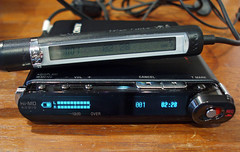
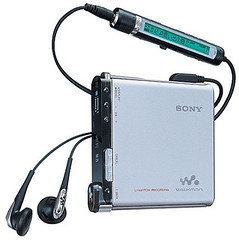
And for those of you interested in a little mediageek-pr0n, I took some pics of the MZ-RH1 when I unpacked it yesterday.
My new Sony MZ-RH1 (oh, how I wish electronics could have actual names, rather than arcane model numbers) arrived this afternoon, one day early. I went home to make sure it didn’t sit out on the front step unattended for half the day.
I’ve had a chance to unpack it and take a quick look, but not put it through its paces. My first impression is that it’s more plasticky than I expected. It’s nice black plastic, but kind of disappointing compared to my first Hi-MD, the MZ-NH1 (just one letter difference) whose body is nice brushed magnesium.
The RH1 has a much nicer and bright OLED display on the unit itself that displays recording/playback meters at the same time as the timer and battery status. It’s not a huge display, but it runs nearly the length of the unit.
Another interesting difference is that the power is supplied exclusively via USB. So the power supply just has a USB out to connect directly to the RH1. I hope that means that the recorder will also charge up when connected to a PC’s USB.
I’ll post more impressions and pictures when I’ve had a little more time to use it. Tonight I plan to test the upload function for legacy MDs.
Without fanfare or any real announcement from Sony, the MZ-RH1 minidisc recorder is now shipping from a variety of sources in North America. This recorder, which may be the last new model ever produced, finally fulfills most of the promise of the minidisc format… a mere fourteen years after MD was first introduced.
Already it looks like most retailers’ initial stocks of the recorder sold out in about a day. Yesterday I watched Minidisco’s online store go from “in stock” to “out of stock,” to “accepting pre-orders for June 29 shipping,” all in about an hour. I grabbed one late in the afternoon from OneCall, whose free 3-day shipping offset the slightly higher price. Just a few hours later they were out of stock, too.
They’ve started showing up on Ebay, too, with plenty of price gouging on the silver colored model, since only the black one is available in the Americas right now.
I sprung for an MZ-RH1 primarily because it has the killer feature of letting you upload audio from all minidiscs directly to you PC, regardless of how they were recorded. Up to now, the Hi-MD standard only allows you to upload any audio recorded using Hi-MD mode, which is now just a couple of years old. But I still have hundreds of hours of audio I’ve produced and recorded in regular (SP) and MDLP modes on older recorders that up to now I’ve had to transfer in real-time.
Now I look forward to more speedily transferring my minidisc archives to my PC so I can then archive the raw audio onto CDs and DVDs. I also plan to make available a lot of the mediageekish audio from the pre-mediageek days.
My new recorder is due to arrive on Thursday, and I will post a review as soon as I’ve had a chance to put it through its paces.
Minidisc.org has confirmation on the new minidisc recorder, MZ-RH1, that I blogged about a couple of weeks ago. The new unit is remarkable both because it’s a sign that Sony isn’t ready to kill minidisc just yet. But also, this model does away with several bothersome limitations.
The MZ-RH1 now allows any audio recorded via the analog or optical digital inputs to be uploaded to a PC. Even better, this model will now upload audio from any legacy minidisc, including regular MDs and MDLP-mode discs, provided the audio was recorded from the analog or digital inputs. Audio transferred from a PC via USB to NetMD recorders won’t be uploadable, presumably because of copyright.
It’s too bad that it’s taken Sony more than three years to realize the full potential of the Hi-MD format, but I’m glad to see it happen. And I find it very tempting to add the MZ-RH1 to my stable (perhaps the last one I ever buy?). I have hours of archives of old radio shows I’ve done and other material I’d love to just upload via USB 2.0 to my PC. Sure, I could do it via a real-time dub, but obviously I haven’t done it yet because of the time involved.
To be fair to Sony, my understanding is that at least one of the hurdles against allowing uploads of legacy MDs was technical, since the Hi-MD spec marked a major change. But I’m glad to see Sony overcome it both technologically and philosophically.